


One fact sells this car before you say anything else about it, and it is not a specification. The Kia EV5 is the first battery-electric Kia ever exported out of China. Built at the Yancheng joint venture site rather than in Korea, on the Chinese market from 2023, shipping abroad a year later.
For an importer, that one line rewrites the entire sourcing conversation. You are not standing in front of a nervous customer explaining an unknown nameplate. You are selling a Kia, sourced from China. Which is a very different sentence, and a much shorter one to deliver.
Exterior
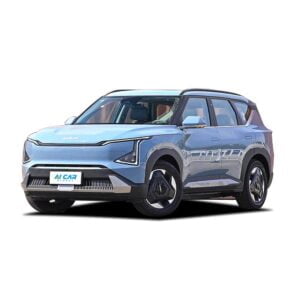
Think of the Kia EV5 as a shrunken EV9, and honestly, that is a good thing to be. Kia committed hard to the boxy, upright look on its electric cars, and this one kept it. Boxy sells. It reads as space inside, and space inside is what your customer is actually shopping for when they walk onto your forecourt with a family and a budget. Now, the tape. Length sits at 4,615 mm, and width and height at 1,875 mm and 1,715 mm respectively — with the wheelbase running 2,750 mm.
Those are compact SUV figures on paper. Stand next to the car and you would not guess it. The slab sides and the upright glasshouse do the work there, and the perception is what your buyer reacts to when they walk up to it. I would argue the perception matters more than the millimetres, because nobody arrives at your showroom carrying a tape measure. They arrive carrying an impression.
Up front there is a closed-off nose, a slim vertical set of daytime running lights, and Kia’s star-map light signature. Flush-ish handles down the flanks. Black cladding over the arches. A floating roof on the higher trims. The tail is clean and wide, with a full-width light bar and a roof spoiler that does a little genuine work on drag.
Wheels run 18 to 20 inches by trim. Two practical notes for you, and both of them will surface after delivery if you skip them. The first is the charge port. It sits on the front right fender on most versions, and in markets where drivers expect it on the rear left, you will hear about it. Every single time. Check it against local charging habits before you order, because this is a habit your customers already have and you cannot train it out of them.
The second is paint. The cladding and matte finishes on certain trims are harder to repair than plain paint. That is a bodyshop cost you carry for years, not a styling quibble, and you should price it into your aftersales plan rather than discover it on your first insurance claim.
Interior
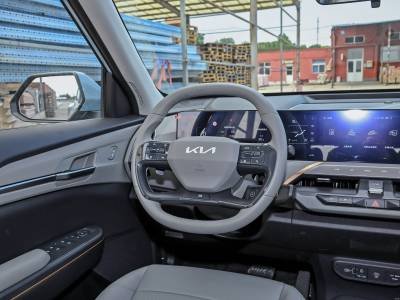
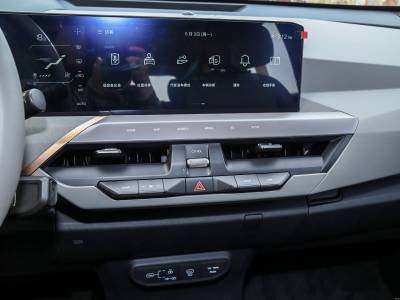
Inside, it is more conventional than the outside promises, and I mean that as a compliment. A 12.3-inch touchscreen. A 12.3-inch driver display. Both sitting under one curved panel, with a small 5-inch climate strip parked between them. Physical buttons survive for volume and a handful of key functions. Good. Somebody at Kia was still paying attention. Ask anyone who has tried to change the volume on a car with no knobs while wearing gloves.
Climate and drive mode, on the other hand, live in the screen — which I could live without. The layout is learned inside a day, though, and no customer has ever walked away over it, so I would not spend your training budget there. Materials vary a lot by trim, and this is a decision, not a footnote. Base cars get hard plastics on the door cards where a rival at that money would still be using soft-touch. Step up and you get synthetic leather, heated and ventilated front seats, a heated steering wheel, a panoramic roof.
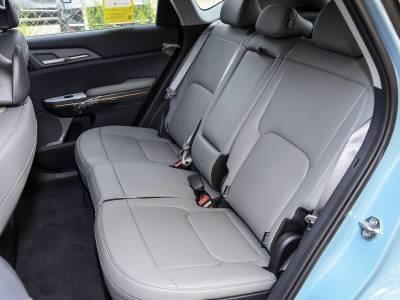
Which trim you import changes what car you are selling. Order the base car into a market that shops against European rivals and you will spend every sales conversation explaining the door cards. Rear legroom is genuinely generous, and the flat floor plus that long wheelbase for the class is the reason. Three across the back is realistic rather than a brochure claim, and it is worth demonstrating to customers rather than asserting.
Cargo sits around 513 litres with the bench up. Rear-drive versions add a small frunk for the charging cables, which sounds trivial until a customer asks where the cables go and you do not have an answer. Two more things I would flag, and the second one is the important one.
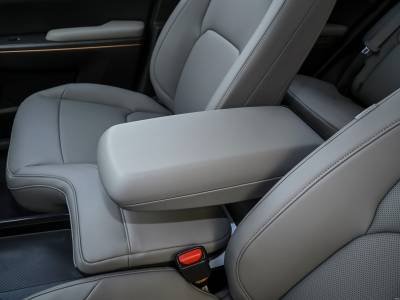
The sliding centre console is a clever idea with genuinely good storage, and the geometry gets awkward on right-hand-drive conversions. If your market drives on the left, sit in one before you commit. Not a photograph. Sit in one. And the sustainability-trimmed versions use recycled fabrics that look excellent on day one and may not wear as gracefully as standard cloth in hot, dusty markets. No point pretending otherwise. Ask for a wear sample and put it through a week of abuse before you commit to a container load. That request costs you nothing. Skipping it costs you a parts claim.
Powertrain and Chassis
Here is the core of the car, and here is where you decide whether the Kia EV5 fits your market at all. Single motor first, because that is what most of your order book will be. It drives the front wheels, and it puts out 160 kW — 218 PS in the figures your customers actually read. Down the strip, 0-100 km/h takes somewhere between 8.5 and 8.9 seconds.
On paper that is not a fast car. It is not meant to be. The front-drive Kia EV5 feels calm rather than quick, which is precisely what family buyers in this segment are looking for and precisely why it sells. Nobody test-driving this with two child seats in mind is disappointed by it. There is also a dual-motor all-wheel-drive layout at 233 kW, or 317 PS, for the markets where winter grip is the argument. Both versions use lithium iron phosphate chemistry, in a 64.2 kWh pack or an 88.1 kWh one.
Now the range figures, and then the lecture that goes with them, because this is where dealers get burned. Standard pack, front drive: 530 km on CLTC. Long-range pack, front drive: 720 km. Long-range pack, all-wheel drive: 630 km. Slow down and read that again. Those are CLTC numbers, and CLTC is a generous Chinese test cycle. It typically reads well above what a European WLTP test gives you, and further above a real highway run in cold weather.
So here is the commercial decision, and it is worth real money. If you advertise 720 km to a buyer in a cold market, you will spend the next two years explaining the gap while your competitor quotes a smaller, honest number and takes the repeat order. Quote range with the cycle named. It protects your own reputation. Do not advertise the bare figure. Ever.
The chassis is a conventional arrangement, and conventional is fine here. MacPherson struts at the front, a multi-link rear, and the battery pack sitting low in the floor where it does the most good for body control. Ride quality on the 19-inch wheels is decent over broken asphalt, which is the surface most of your customers will actually drive on. The 20-inch fitment on top trims adds a sharpness that a lot of markets will find too firm for the roads they have. Spec wheels to your market rather than to your catalogue. This is the single easiest specification decision you will make, and one of the most visible to the customer.
Charging is quoted at roughly 30 to 80 percent in under half an hour on DC, and the car supports vehicle-to-load for running tools or a kettle. Fleet buyers like that. So do market traders, and so does anyone who has ever tried to work out of the back of a van. For a fleet buyer weighing this against a cheaper no-name Chinese EV, here is the honest trade. The Kia EV5 is not the cheapest route to 700 km of CLTC range. Not close. What you are paying the difference for is a badge your customers already trust, a parts network that exists today rather than one you would have to build, and a resale conversation that does not start with an argument. In markets where unknown Chinese EVs scare off retail buyers, that is worth real money on your forecourt, and it is the easiest part of this car to sell.
FAQ
Where is this thing actually built, and does that matter? China, at Kia’s Yancheng joint venture plant rather than in Korea. That is the whole reason this car exists as an export product. It reached the Chinese market in 2023 and started shipping abroad the following year, and it holds the distinction of being the first battery-electric Kia exported out of China. That single line is worth more in a sales conversation than any number on the spec sheet, because it answers the one question every cautious buyer asks first: is this really a Kia?
How much range will my customers actually get, not the brochure number? Reality first. With the 64.2 kWh pack, Kia quotes 530 km. With the 88.1 kWh pack in front-drive form, up to 720 km, or 630 km for the long-range all-wheel-drive version. All three of those are CLTC, a Chinese cycle that runs more generous than WLTP and considerably more generous than a real highway run. So build your customer messaging around the gap rather than the headline figure, and you will not be the dealer who has to explain the difference eighteen months later.
Front-wheel drive or all-wheel drive — which should I stock? Both exist, and the choice is really a question about your winters. The single-motor car puts out 160 kW, or 218 PS, drives the front wheels, and reaches 100 km/h from rest in 8.5 to 8.9 seconds. The dual-motor car makes 233 kW, or 317 PS, and drives all four wheels — worth stocking where winter grip is a genuine selling point rather than a footnote in a brochure. Neither version is a performance car. Neither needs to be, and I would not let a salesperson imply otherwise.
Can we import the Kia EV5 into our market? In markets with no import certification requirement it ships directly. Several regions require type approval instead, and the EU is the common case. We confirm whether the exact trim you want can be supplied with the certification your market asks for, before you commit to anything. As the importer you carry the compliance decision, so we make sure you are making it with accurate information rather than optimism.
How do you supply the EV5, and how do we start? We are a China-based vehicle export company. We source from the manufacturer and run the export side: documentation, ocean freight, and delivery to your port. Most of our buyers are overseas dealers and importers who want a supply line they can plan around, and we also help individual buyers. Send us your market, your trim and a rough volume, and we will confirm stock, shipping route and destination paperwork. That first reply costs you nothing, and it tells both of us quickly whether your market and this car are a fit.
| 2024 Kia EV5 530km |
|
|---|---|
| Basic Information | |
| Availability | 2023.11 |
| vehicle class | Compact SUV |
| Length*Width*Height(mm) | 4615*1875*1715 |
| Type of energy | all-electric |
| CLTC pure electric range (km) | 530 |
| Total motor power (kW) | 160 |
| Total motor torque (N-m) | 310 |
| Maximum speed (km/h) | 185 |
| Battery Type | lithium iron phosphate battery |
| Battery capacity (kWh) | 64.2 |
| Fast charging time (h) | 0.45 |
| Fast charging capacity (%) | 30-80 |
| Warranty Policy | Five years or 100,000 kilometers |
| body of automobile | |
| Length (mm) | 4615 |
| Width (mm) | 1875 |
| Height (mm) | 1715 |
| Wheelbase (mm) | 2750 |
| Front wheelbase(mm) | 1614 |
| Rear wheelbase(mm) | 1619 |
| Weight (kg) | 1870 |
| Luggage compartment volume (L) | 513-1718 |
| Number of doors (pcs) | 5 |
| Number of seats (pcs) | 5 |
| electric motor | |
| Total motor power (kW) | 160 |
| Total motor torque (N-m) | 310 |
| Maximum power of front electric motor (kW) | 160 |
| Maximum torque of front motor (N-m) | 310 |
| CLTC pure electric range (km) | 530 |
| Battery capacity (kWh) | 64.2 |
| Fast charging time (h) | 0.45 |
| Motor structure | permanent magnetism |
| Principle of motor operation | synchronization |
| Number of drive motors | single motor |
| Motor Layout | preamplifier |
| Battery Type | lithium iron phosphate battery |
| Battery Cell Brands | Ferdi (surname) |
| Battery cooling method | liquid cooling |
| fast charging function | be in favor of |
| Fast charging capacity (%) | 30-80 |
| Battery Pack Warranty | Eight years or 150,000 kilometers |
| Battery preheating | ● |
| Chassis/steering | |
| Driving form | front drive |
| Front suspension type | MacPherson independent suspension |
| Rear suspension type | Five-link independent suspension |
| Steering assist form | electric power assist |
| Wheels/Brakes | |
| Front/Rear Brake Type | Ventilated Disc Type / Disc Type |
| Parking brake type | electronic parking |
| Front Tire Specification | 225/60 R18 |
| Rear Tire Specification | 225/60 R18 |
| Wheel Material | aluminum |
| Spare tire specification | Tire Repair Tools |
| Active/passive safety features | |
| ABS anti-lock | ● |
| Brake force distribution (EBD/CBC etc.) | ● |
| Brake Assist (BA/EBA/BAS etc.) | ● |
| Traction control (ASR/TCS/TRC etc.) | ● |
| Stability Control (ESC/ESP/DSC etc.) | ● |
| front exhaust airbag | :: Driver's airbag |
| ●Passenger airbag | |
| ●Side airbags | |
| ●Head airbags (air curtains) | |
| Rear airbags | ●Head airbags (air curtains) |
| Tire Pressure Detection Device | ●Display |
| Seat Belt Reminder | ●Principal Driver |
| ●Passenger | |
| ISOFIX child restraints | ● |
| Auxiliary/Manipulation Configurations | |
| parking radar | ●Forward |
| ● Post | |
| Driver Assistance Video | ● Backup camera |
| cruise control | ●Cruise control |
| Driving Mode Switching | :: Campaigns |
| :: Economy | |
| :: Standard/comfort | |
| :: Snow | |
| steep incline and slow descent | ● |
| hill-holding aid | ● |
| automatic parking | ● |
| External/anti-theft configurations | |
| roof rack | ● |
| Concealed power door handles | ● |
| Key Type | ●Remote key |
| Keyless entry | ● |
| Keyless Start System | ● |
| Remote start function | ● |
| Central locking in the car | ● |
| Internal Configuration | |
| Steering wheel material | :: Plastics |
| Steering Wheel Adjustment | ● Manual |
| Adjustable up and down | |
| Adjustable front and rear | |
| Steering wheel functions | :: Multifunctionality |
| center armrest | ●Forward |
| ● Post | |
| Sun visor vanity mirror | ● |
| Liquid crystal instrument size | 12.3 in. |
| Intelligent Hardware | |
| Number of cameras | :: 1 |
| Number of ultrasonic radars | :: 8 |
| seating | |
| Seat Material | :: Fabrics |
| Integral adjustment of the main driver's seat | ●Before and after |
| ●Backrests | |
| ●High/Low (4-way) | |
| Passenger seat overall adjustment | ●Before and after |
| ●Backrests | |
| Second row seat adjustment | ●Angle adjustable |
| ●Proportional lowering | |
| Rear Cup Holder | ● |
| multimedia | |
| Large color screen in the center console | ● |
| satellite navigation system | ● |
| Navigating the road information display | ● |
| Map Branding | Baidu |
| Roadside assistance calls | ● |
| In-vehicle Intelligent System | ●Kia Connect |
| Automotive Intelligence Chip | ●NVIDIA Parker |
| Mobile APP Remote Function | ●Door control |
| ● Vehicle start-up | |
| ● Charge management | |
| ● Air conditioning control | |
| :: Vehicle condition check/diagnosis | |
| :: Vehicle location/search | |
| Bluetooth/Car Phone | ● |
| Cell phone connectivity/mapping | ●CarPlay support |
| ●CarLife support | |
| Number of audio speakers | 6 |
| Center screen size | ●5 inches |
| ●12.3 inches | |
| 4G/5G networks | ●4G |
| Telematics | ● |
| OTA upgrade | ● |
| Interface Support | ●Type-C port |
| (stage) lighting | |
| low beam (headlights) | ●LED |
| high beam (headlights) | ●LED |
| LED daytime running lights | ● |
| Adjustable headlights | ● |
| Automatic headlights | ● |
| Delayed headlight off | ● |
| Glass/Mirror | |
| power window | ●Forward |
| ● Post | |
| One-touch window lifting | ●Principal Driver |
| Anti Window Pinch Handle | ● |
| rearview mirror | ●Motorized adjustment |
| ●Heating | |
| rearview mirror | ○Automatic anti-glare |
| ●Manual anti-glare | |
| Air conditioners/refrigerators | |
| Air conditioning control method | ● Automatic control |
| rear air vent | ● |
Fill out the form to receive a business quote
Ask your question now and receive an answer within one business day.








Reviews
There are no reviews yet.